Why rotate around center of mass
If you don’t rotate an object around its center of mass, it becomes unstable - causing vibrations, extra stress, and sometimes complete system failure.

- #2492
- 12 Sep 2025
If you don’t rotate an object around its center of mass, it becomes unstable - causing vibrations, extra stress, and sometimes complete system failure.

You’ve probably seen a spinning fan or display with LED lights that forms text or images in mid-air — it looks like magic! But what’s really happening?
This amazing effect is based on a concept called Persistence of Vision (POV). When an LED strip spins fast enough and its lights turn on and off at just the right times, your brain blends those quick flashes together. The result? You see a complete image - even though it’s really just a single line of lights moving in circles!
What is a Capacitor?
A capacitor is an electronic component that stores electrical energy in an electric field. You can think of it like a tiny rechargeable battery, but it charges and discharges much faster and can’t hold energy for very long.
Why Are Voltage Regulators Important?
They protect components from getting too much or too little voltage.
They keep the power supply stable.
They make electronic devices more reliable and last longer.
Tools & materials needed for drilling.
Step-by-step drilling technique.
How to keep yourself safe in the process.

Here, we’ve listed all the tools and skills you need to solder and desolder components using THT (Through-Hole Technology).

In the image below, you'll see where to connect the power source and the motor to the motor speed controller.
In the image below, you can see the "electrical contacts" of the motor pointer with blue arrows.
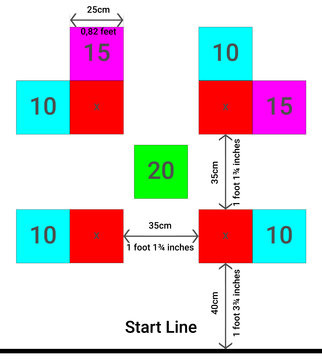
Sites are outlined on the mat wireframe.
No Equipment Constraint: The mission model cannot earn points if it is touching equipment at the end of the match.
Sand is considered completely cleared when the pull activator is past the line on the mat.
No Equipment Constraint: The mission model cannot earn points if it is touching equipment at the end of the match.
Technicians may open ore blocks by hand to reveal the fossilized artifact when completely in home (see Mission 14).
No Equipment Constraint: The mission model cannot earn points if it is touching equipment at the end of the match.
Your team’s minecart must pass completely through the mineshaft entry to score points for this mission.
It is not possible to earn the bonus if there is no opposing team or in remote competitions.
No Equipment Constraint: The mission model cannot earn points if it is touching equipment at the end of the match.
So far, we’ve explored a line-following algorithm commonly referred to as duck walking. Let’s take a closer look at how it works and consider how many distinct states it actually involves.
In more advanced robotics programming, your robot may need to respond in three or more different ways depending on sensor input. Up to this point, we've created programs with only two possible outcomes using a switch block: a condition is checked, and the robot performs one action or the other based on the result.
But what if the robot needs more than just two responses? To handle this, we can use multiple conditions—often implemented with nested switch blocks or structured decision chains. In this section, we’ll explore how to build programs that go beyond binary choices and enable your robot to react intelligently to more complex environments.
When you hear the task “program the robot to follow a black line,” you’ll most likely imagine a program that works like this: