
FIRST LEGO League 2026-2027 BIOGLOW Future Edition preparation
Get ready for the FIRST LEGO League 2026-2027 BIOGLOW Future Edition season with free detailed 3D building instructions for all mission models.
- 0:00
- 0
Courses are used by teachers to organize STEM classes. Students move through the videos and solve the tasks. Teachers guide them. The courses are ordered by last published.
Get ready for the FIRST LEGO League 2026-2027 BIOGLOW Future Edition season with free detailed 3D building instructions for all mission models.
Get ready for the FIRST LEGO League 2026-2027 BIOGLOW season with free detailed 3D building instructions for all mission models.
You'll also discover expert tips and tricks - including references to previous competitions - to inspire creative, effective ways to approach and complete the missions.
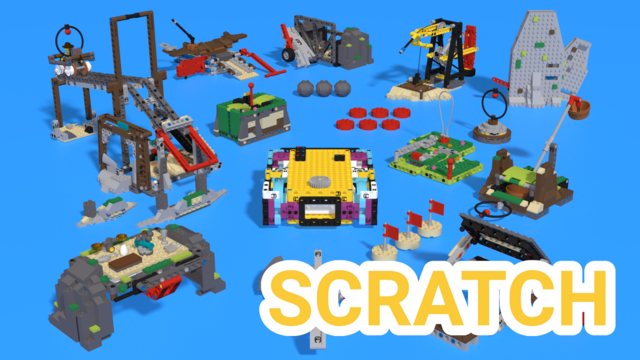
The FIRST LEGO League 2025-2026 UNEARTHED competition challenges teams to recover artifacts, work around delicate structures, and complete several actions efficiently. This course explores practical solutions using the compact Smaller Pancake box robot.
You’ll study a variety of mission strategies and attachment designs, including active and passive mechanisms, gears, hooks, rubber bands, gravity-powered actions, and alignment techniques. The tutorials explain not only what the robot does, but also why each design and programming decision improves the run.
Each main tutorial is paired with a 10 out of 10 reliability test, showing how consistently the solution performs and how details such as starting position, tire grip, attachment preparation, and mission-model movement can affect the result.
To support fair play, our complete mission solutions are published only after the season has ended. Before starting the course, we recommend reviewing the FIRST LEGO League robot game guide.
This is the first level of the LEGO Robotics Curriculum with Python, designed for students in grades 4 and up.
In this robot adventure, students learn to control robots using real Python code, while teachers guide them through their first steps in text-based programming. Throughout the level, students build a variety of LEGO SPIKE Prime robot models and program them to move, turn, and complete tasks with increasing precision.
Step by step, students learn how to read, understand, and write their own Python programs. Through fun and creative challenges, they bring their robots to life and discover how code can control movement, solve problems, and interact with the world. Along the way, they explore concepts such as navigation, obstacle avoidance, and sensor-based behavior.
The curriculum is designed to help teachers introduce programming in an engaging and approachable way while giving students plenty of opportunities to experiment, test ideas, and develop confidence in their coding skills.
By the end of the level, students apply everything they have learned in an exciting robotics competition. Using their own programs and robot designs, they complete missions on a competition field with boxes, putting their coding, engineering, and problem-solving skills to the test.

The sixth level of the Robotics with LEGO curriculum is designed for students in third or fourth grade.
For the first time, two different robots are required to solve a challenge. Students learn how to cooperate, agree on a shared plan, and divide their roles. They build a variety of robots, including a crane that loads a sorter. Students also use two sensors at the same time to locate their target and to check whether their partner robot is ready to complete its part of the challenge.
Discover the fun of DIY electronics with your child in this self-paced, beginner-friendly online course, where parents and kids work together to build a rotating LED strip display!
Designed for those with no prior experience, this project-based course walks you through the entire process of assembling a spinning LED display that uses persistence of vision to create a glowing clock.

This is the fifth level of the LEGO Robotics Curriculum, designed for students in second, third, or fourth grade.
Musical Instruments Level: Each lesson centers on a theme connected to music and musical instruments. Students explore pitch, volume, and duration of sounds, as well as how to read and program musical notes on the SPIKE Prime Hub. This level introduces sound-related blocks, force and speed sensors, and math blocks for division and absolute values, building on students’ existing knowledge.

Get ready for the FIRST LEGO League 2025-2026 UNEARTHED season with free detailed 3D building instructions for all mission models.
You'll also discover expert tips and tricks—including references to previous competitions—to inspire creative, effective ways to approach and complete the missions.
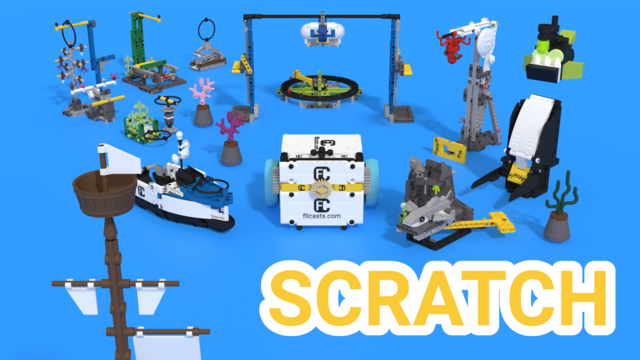
Ready to dive deep into the 2024-2025 FIRST LEGO League SUBMERGED season? In this hands-on course, we showcase and explain a series of expertly crafted example solutions using the versatile Nautiq box robot and powerful custom-built attachments.
Unlike others, we release our solutions only after the season ends, ensuring fair play while providing full transparency. What sets this course apart is our strong focus on multi-mission runs - watch and learn how to complete 3, 4, or even 5 missions in a single program. Then, we break everything down mission by mission so you can replicate, tweak, and fully understand the strategies and logic behind each run.
This course is more than a demonstration - it's a teaching tool. Whether you're a student eager to master robotics or a coach looking to elevate your team's performance, you'll gain practical insights into how to score more points efficiently and creatively in FLL competitions.
And with the Nautiq, the fun is just getting started! You’ll explore the power of gears, the magic of attachments, and the surprising capabilities of a compact robot that packs a serious punch. Get inspired, get building, and bring your FLL journey to the next level!
Before starting this course, we recommend reviewing the FIRST LEGO League robot game guide.

In this course, we demonstrate and explain example solutions for the FIRST LEGO League 2023-2024 MASTERPIECE competition using the Chain Monster box robot as a base, with custom-built attachments. Each solution is powered by a Python program that controls the robot to accomplish various missions efficiently. Every year, we share our solutions and insights only after the season is over.
The course is unique in its focus on multiple missions in a single run, showcasing runs that complete 3, 4, and even 5 missions in succession. We not only analyze these runs but also dive into the details of each individual mission, explaining the programming logic behind them. By following this course, you’ll gain a deeper understanding of how Python is used to automate mission execution and optimize your team's performance in FLL competitions.
Before starting this course, we recommend reviewing the FIRST LEGO League robot game guide.

In this course, we demonstrate and explain example solutions for the FIRST LEGO League 2023-2024 MASTERPIECE competition using the MiniBox box robot as a base, with custom-built attachments. Each solution is powered by a Python program that controls the robot to accomplish various missions efficiently. Every year, we share our solutions and insights only after the season is over.
The course is unique in its focus on multi-mission runs, showcasing runs that accomplish 3, 4, and even 5 and 6 missions. We then dive into the details of each specific mission. As you follow the course, try replicating the solutions to better understand the programs and explanations. This approach teaches students and teachers the principles of accomplishing missions in FLL robotics competitions and how to help your team score more points. Moreover, with the MiniBox, you will definitely have fun leaving the attachments on the mat. That will save you some precious time preparing for the next run!
Before starting this course, we recommend reviewing the FIRST LEGO League robot game guide.
In this course, we demonstrate and explain example solutions for the FIRST LEGO League 2023-2024 MASTERPIECE competition using the MiniBox box robot as a base, with custom-built attachments. Every year, we share our solutions and insights only after the season is over. The course is unique in its focus on multi-mission runs, showcasing runs that accomplish 3, 4, and even 5 and 6 missions. We then dive into the details of each specific mission. As you follow the course, try replicating the solutions to better understand the programs and explanations. This approach teaches students and teachers the principles of accomplishing missions in FLL robotics competitions and how to help your team score more points. Moreover, with the MiniBox, you will definitely have fun leaving the attachments on the mat. That will save you some precious time preparing for the next run!
Before starting this course, we recommend reviewing the FIRST LEGO League robot game guide.

This is the Line Following course, where you’ll explore essential techniques to help your LEGO robot follow a line with accuracy and stability! We will begin by covering the fundamental concepts of line following, starting with basic wobble line following, which teaches how robots detect and respond to lines. Then, we'll progress to more advanced methods like proportional line following, allowing smoother tracking by adjusting speed based on error values. Finally, you'll dive into the widely-used PID line following technique, where you'll learn how to tune parameters for optimal robot performance. Whether you're a beginner or looking to enhance your robotics skills, this course will guide you through building, coding, and refining your robot's line-following capabilities.

In this course, we demonstrate and explain example solutions for the FIRST LEGO League 2023-2024 MASTERPIECE competition using the Chain Monster box robot as a base, with custom-built attachments. Every year, we share our solutions and insights only after the season is over. The course is unique in its focus on multiple missions in a single run, showcasing runs that accomplish 3, 4, and even 5 missions. We then dive into the details of each specific mission. As you follow the course, try replicating the solutions to better understand the programs and explanations. This approach teaches students and teachers the principles of accomplishing missions in FLL robotics competitions and how to help your team score more points.
Before starting this course, we recommend reviewing the FIRST LEGO League robot game guide.

This is the fourth level of the LEGO Robotics Curriculum for students in second, third, or fourth grades.
Competitive Introduction Level: Each lesson has a theme related to various LEGO robotics competitions. Students learn about FIRST LEGO League, Line Following, and Sumo Wrestling. A new color sensor is introduced, and students use forever loops, wait until commands, and if/else statements in new ways.

This is the third level of the LEGO Robotics Curriculum for students in second, third, or fourth grades.
Carnival and Amusement Park Level. Each lesson has a theme related to carnivals and amusement parks. Students learn about physics concepts of inertia, center of mass, and centrifugal force. New ways of programming the force and distance sensors are introduced. We work with new concepts: forever loop, if/then, and if/else.

This is the second level of the LEGO Robotics Curriculum for second, third, and fourth-grade students.
In this level, we will focus on History and Mythology, with each lesson covering a different aspect of the ancient world. You will learn about a new distance sensor that uses ultrasound to help a watchtower robot detect invaders. We will also introduce new concepts such as loops, degrees, and a third motor. Additionally, you will learn how robots can perform two different tasks simultaneously.

In this course, we demonstrate and explain example solutions for the FIRST LEGO League 2022-2023 SUPER POWERED competition using the Kriket box robot as a base and building attachments for it. Every year, we share our solutions and our comments only after the season is over. The course is centred around MULTIPLE MISSIONS in a single run which is unique. We see runs with 3, 4 and even 5 missions. Then we enter into details around accomplishing the specific missions. You can follow the course, and as you go through each mission, try to replicate the solutions to understand the programs and explanations. This teaches students and teachers the principles of accomplishing missions in every FLL robotics competition and how to help your team score more points.
Before starting this course, we suggest you go through the FIRST LEGO League robot game guide
There is an additional course that does a review for the same competition but with a different robot - the Chain Monster. It present other principles of building attachments and shows different examples. Check out the other course also. FIRST LEGO League 2022-2023 Super Powered solutions and review with Chain Monster box robot from LEGO Education SPIKE Prime

The goal of this course is to help teachers, mentors and teams with a week by week schedule of how they could approach the FLL season if they have about 16 weeks, each week one class of 45 minutes. This course is complimentary to the already existing structure of Prepare for FIRST LEGO League Robot Game. The complete guide. The course gives an example of a structure based on weeks and classes.
The course also makes a few suggestions about the innovation project and how it could be approached.
This course is in the development.

In this course, we demonstrate and explain example solutions for the FIRST LEGO League 2022-2023 Super Powered competition. Every year, we share our solutions and our comments only after the season is over. The course is centred around MULTIPLE MISSIONS in a single run which is unique. We see runs with 3, 4 and even 5 missions. Then we enter into details around accomplishing the specific missions. You can follow the course, and as you go through each mission, try to replicate the solutions to understand the programs and explanations. This teaches students and teachers the principles of accomplishing missions in every FLL robotics competition and how to help your team score more points.
Before starting this course, we suggest you go through the FIRST LEGO League robot game guide
There is an additional course that does a review for the same competition but with a different robot - the Kriket box robots. It presents other principles of building attachments and shows different examples. Check it out! FIRST LEGO League 2022-2023 SUPERPOWERED solutions and review with Kriket Box robot from LEGO Education SPIKE Prime

Very often we need additional parts to build more complex attachments to increase our chance of winning the competition. These are parts outside of the LEGO Education SPIKE and LEGO Mindstorms sets. That is why, most teams decide to purchase parts that are not included in the official sets.
The FLLCasts team have prepared a list of recommended additional parts each team should have in order to be more successful. Of course, you can decide whether to buy more or less of each item depending on your budget.
Parts could often be found on bricklink.com and rebrickable.com
In the following course we would focus on the type of the recommended parts, share a list of them and publish tutorials on how these parts could be used to accomplish different missions. Our goal is to answer the questions "What could be done with LEGO?", "What parts are available 'out there'?
В много от занятията отборите работят върху един робот, като всеки отбор е отговорен за правилното реализиране на поетата от тях функционалност. Задълбочено се разглеждат задаването на входни стойности и използването на изходните стойности на всички блокове. Широко се използват променливи от трите основни типа: Integer, Boolean, Text. Роботите вече пазят богато вътрешно състояние, могат да броят, да изчисляват, да се обосновават логически, с помощта на което взимат много по-правилни решения. Въвежда се използването на паралелно изпълняващи се блокове.
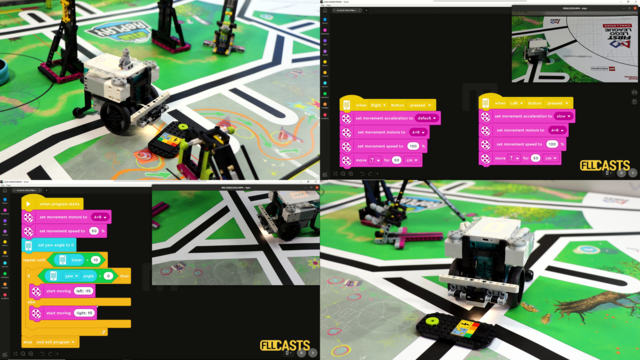
To successfully advance at competitions we need to understand two concepts - how to reliably and consistently navigate the field and position the robot exactly where we need it to be on every run, and how to build attachments that would accomplish a mission model once we have reached it. This course is focused on the first part. The second part is the whole FLLCasts platform, but start at FIRST LEGO League with LEGO Mindstorms Robot Inventor. "Challenge" competition for 9-16 years old.
The goal of this course is to help you learn to program LEGO Robots using Scratch and make them behave consistently and reliably during competitions. As a language we use LEGO MINDSTORMS App Word Blocks which is based on Scratch. We look at a lot of concepts that could be used for FIRST LEGO League and World Robot Olympiad competitions - for example, how to follow a line fast, slow, in a smooth way, with 5 states. Also, how to align to lines, how to do double align, how to keep a straight line with a motion sensor.
Unfortunately, LEGO discontinued the robot series during the making of this course which is why it's kind of shortish. You could use the SPIKE Prime course for a more in-depth analysis.


