

Tetrix FTC. Cut a pipe with an opening with specific shape. User a template
Take the hacksaw, the drill and let's cut the pipe.
- #581
- 28 Jun 2017
Take the hacksaw, the drill and let's cut the pipe.

In this 10 out of 10 tutorial, we accomplish the Platooning Trucks from FIRST LEGO League (FLL) 2021-2022. The goal of the mission is to connect the trucks to each other and both of them to the bridge. The attachment and the robot pushes the trucks and we do it 10 times to see the consistency and reliability of the robot.

In this video tutorial, we demonstrate a configurable attachment used for accomplishing a FIRST LEGO League 2021-2022 Cargo Connect mission called Sorting Center. The mission model has three cargo objects that are placed randomly. The attachment is configured before the run based on the configuration of the cargo objects. This attachment is also very powerful as it aligns and auto-corrects the errors that the robot is making by squaring the robot.

This is a 10 runs tutorial that demonstrates how the accuracy of the robot improves when we use slow acceleration vs fast or default acceleration. Note that the improvement is small. This is not an accurate and consistent robot. No. This is a robot that is all but accurate or consistent. It does not use sensors and you should use sensors. But it is a teaching/demonstration moment for everybody to seen what is it that you can expect if you don't use sensors.

Similar to the tutorial for the LEGO Education SPIKE Prime this tutorial again accomplishes the cell phone mission. The mission is to flip the phone and is part of the FIRST LEGO League 2020 RePlay competition.

In this video tutorial we accomplish the Boccia mission from the FIRST LEGO League 2020 RePlay competition. We use LEGO Mindstorms Robot Inventor robot. In this mission we use an attachment that does three things in the same time - align, push one lever and drop a couple of boxes in a target. It is a complex attachment and it is worth the watch.

This is a true 10 out of 10 video tutorial. The robot accomplishes the Weight Machine mission from the FIRST LEGO League 2021 RePlay competition every single time. The attachment demonstrate a mechanism that performs and is stable on every try

The task is to find what the best seed is that will live the longest without entering into a loop or without dying. Find it and submit in the tasks section.

In this video tutorial, the MiniBox box robot accomplishes M14 and M15 of the FIRST LEGO League 2023-2024 MASTERPIECE Challenge robotics competition. The robot is a LEGO Education SPIKE Prime robot. In this run, the robot delivers the LEGO minifigures to their designated places.

In this video tutorial, the MiniBox robot accomplishes M08 and M09 of the FIRST LEGO League 2023-2024 MASTERPIECE Challenge robotics competition.
The MiniBox, a LEGO Education SPIKE Prime box robot, uses a detachable attachment to release the camera down the track for M08 Rolling Camera. Then, with a slight turn, it pulls the M09 Movie Set boat model and positions it in its designated spot. Let's take a look!

On every FIRST LEGO League competition and generally robotics competitions with LEGO robots, we build attachments to accomplish missions and we must accomplish the missions in a limited amount of time. Most of the time we can not accomplish the missions with a single attachment and we have to change attachments. This is where building robot attachments that are easy to remove really makes sense. In this tutorial we discuss some of the things that should be considered in the building Easy to Detach modules and attachments

In this video tutorial we discuss probably the most useful principle that we've found for FIRST LEGO League competitions and this is how to align to a line with two color sensors. We use the LEGO Mindstorms Robot Inventor for a quick demonstration of the principle. In the LEGO Mindstorms Robot Inventor Programming course we enter into more details of how exactly we program the sensors. The current tutorial demonstrates the use of such a program and makes clear why this could be very useful and is a must for any well prepared team and wants to achieve a good score on the competition.

The goal of the Innovation project mission is probably to give everybody an easy win on the competition. A mission that does not require an attachment or a complex program and it the same time is quite interesting. In this video tutorial you will see our robot and our innovation project construction, along with how we complete the mission. Hope you like them!

This FRIST LEGO League video tutorial is about he Boccia Share mission from FIRST LEGO League 2020 RePlay competition. In the tutorial we demonstrate how to push on a lever to release a mission model part - in this case a box. You have the choice before the competition to cooperate with the other team and to decide if you are going to do the blue or the red box.
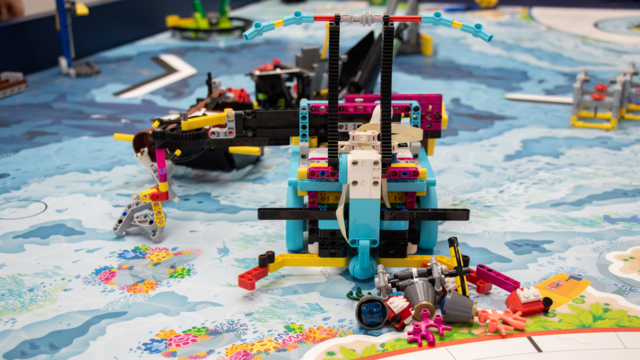
This video tutorial focuses on accomplishing M05 Angler Fish, M09 Unexpected Encounter, M10 Send over the Submersible, and M11 Sonar Discovery of the FIRST LEGO League 2024-2025 SUBMERGED Challenge using the Nautiq box robot (a LEGO Education SPIKE Prime robot). The run uses three attachments in sequence: an aligning attachment at the start to reduce initial inaccuracies, a front attachment for solving M05 and M10 while collecting krill, reef segments, and the water sample, and a back attachment for solving M11, delivering the unknown creature for M09, and collecting plankton and seabed samples.
The front attachment is particularly interesting in this configuration because it integrates two color sensors and one motor directly onto the attachment itself. These sensors are used to align the robot to the black line near M10, while the aligning attachment at the start ensures a precise launch position.
This version of the big run takes on significantly more missions in a single attempt than a standard sequence, which naturally comes at the cost of reduced accuracy. In the current FLL competition format—where only your best score from three attempts is counted—this trade-off can be highly strategic. A run that works perfectly even just once can yield a massive point boost, making this kind of high-reward, lower-consistency approach a potential game-changer for teams willing to take the risk.

This tutorial explains the use of motion and light/color sensors to accomplish a complex mission split into three parts. It gets into detail about how we keep a straight line with the motion sensor, follow a line with the color sensors, and transition between different parts of the program by aligning and detecting lines with the sensor. The goal is to get to a reliable and consistent behavior of the robot. On top of that, it is configurable, as we've left a few parameters that could be set to configure the behavior for a specific robot, venue, lighting, battery level, and wheels friction.

The robotics tutorial is about the shape of the pipe its advantages and disadvantages.
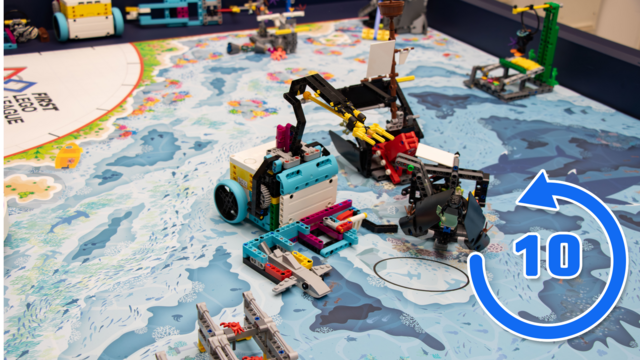
This video tutorial focuses on accomplishing M02 Shark, collecting the trident for M14 Sample Collection, and collecting a Krill for M12 Feed the Whale of the FIRST LEGO League 2024-2025 SUBMERGED Challenge using the Nautiq box robot (a LEGO Education SPIKE Prime robot). In this series of test runs, our goal is to achieve 10 out of 10 successful attempts, meaning the robot completes all three missions flawlessly in every trial.
The robot uses a pinless attachment with locking beams for stability, enabling it to push the shark into its habitat, trigger a drop wall to catch the Krill, and lower a motorized arm with rubber parts to grab the Trident. This efficient approach ensures consistent results across the attempts while maintaining stability and precision throughout the runs. You can watch the full explaining tutorial here.

This is the first video tutorial from our course on LEGO MINDSTORMS Robot Inventor programming. In this tutorial we will start with how do we move without sensors. We will demonstrate a simple program. Our hope with this tutorial is that you will see why moving without sensors is a bad approach.

10 out of 10 for the innovation project mission is quite interesting - move forward, return, move forward, return. In the tutorial you will see how we accomplish the mission every team and how the program is repeatable

In this video tutorial we use an active attachment with a gears, built only form LEGO Mindstorms Robot Inventor parts, to accomplish the FIRST LEGO League 2020 Treadmill mission. The goal of the mission is to rotate the mission model for a couple of seconds so that a pointer makes a half circle rotation. What you will learn is a good principle to approach such missions.

The Slide mission the FIRST LEGO League 2020 is about the LEGO Minifigures sliding down the slide and the robot bringing them back to base. We must somehow bring then back do base. Do we push them on the Slide? Do we pull them? Or we could lift them. In this video tutorial we decided to pull the minifigures, but there is a catch.

This is the task for you. We've shown you in the previous tutorials how to do it, how to use a drill and a hacksaw and a grinding stone to cut and shape a PVC pipe. Now it's your turn. Don't forget to show us pictures -> right here in the comments section

Control the hand of the FIRST Technical Challenge Push Bot robot with the GamePad bumpers.


