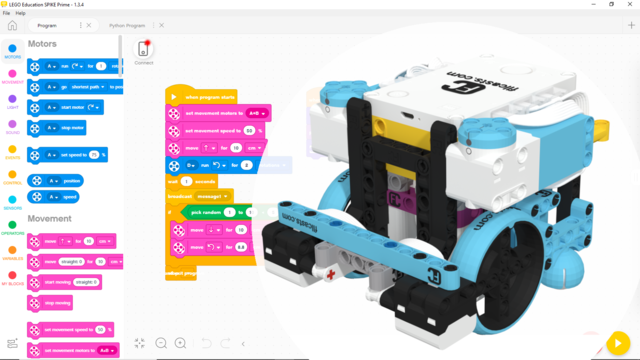
A museum exhibition of a Chicken with LEGO Education SPIKE Prime in 3D building instructions
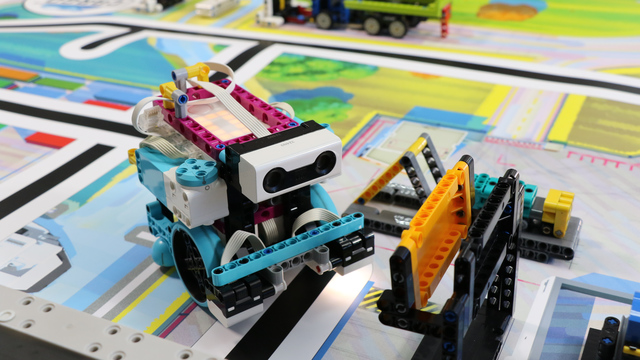
This is the creation of my daughter. She said that this is a "Chicken" exhibited in a museum. Which is nice.
- #1239
- 15 Jan 2021
This is the creation of my daughter. She said that this is a "Chicken" exhibited in a museum. Which is nice.
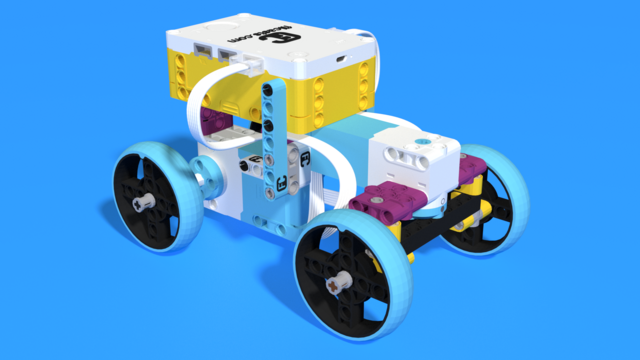
We call active attachments those that are powered with a motor. This one is in the the mission of lifting levers which is common at robotics competitions like FIRST LEGO League/World Robotics Olympiad. The attachment uses Luly, a small LEGO Education SPIKE Prime competition robot with 3D building instructions as a robot base.
This Python program is for controlling Gazon, LEGO Education SPIKE Prime competition robot to accomplish FIRST LEGO League (FLL) 2020 RePLAY Challenge mission 02 - Step counter. Check out the lessons where this program is use for specific demonstrations and explanations on how the program works.
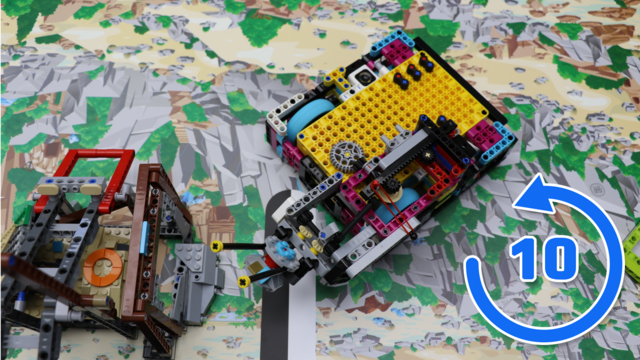
This attachment is part of a second version of attachments for accomplishing the M07, M08 and M15 where we have to push and collect in the FIRST LEGO League 2022-2023 competition. It is for the Kriket Box Robot and we are doing this second version to make sure there are enough examples of how to use the Kriket box robot.
The interesting part about this attachment is how it connects to the robot. The Kriket has two brown axles that are connected to the motors via a gear mechanism. The attachment is attached to these brown axles which transfer the motor movement to the attachment.
While "multistate line following" can describe a variety of algorithms, this tutorial will cover its implementation using the ducky line-following method.
A FIRST LEGO League 2023-2024 attachment for the MiniBox Robot.
This attachment is designed to detach, once it completes its purpose. This is done, so that the team loses less time switching attachments in the base, lowering the chance of human error during the competition.
A simple line-following robot, Seon, can be programmed to follow a line. However, its design does not support basic wobble or "ducky" line-following, requiring a more advanced method instead.
The force sensor can detect how hard it’s being pressed! Here’s how: