Uploading programs to the hub
This tutorial outlines the two ways to upload programs to the SPIKE hub and which one is preferred.
- #1652
- 20 Aug 2020
This tutorial outlines the two ways to upload programs to the SPIKE hub and which one is preferred.
This tutorial in an animated demonstration of how a LEGO Education SPIKE Prime robot turns to the left and to the right. To download the program check out the courses in which the tutorial is used.
“Doing the same with less” can save time and space.
We start with the first mission - trying to build attachments that are small and tidy and the Gazon robot allows us to do so. With a few pictures you can see how the robot should be placed along with all the attachments
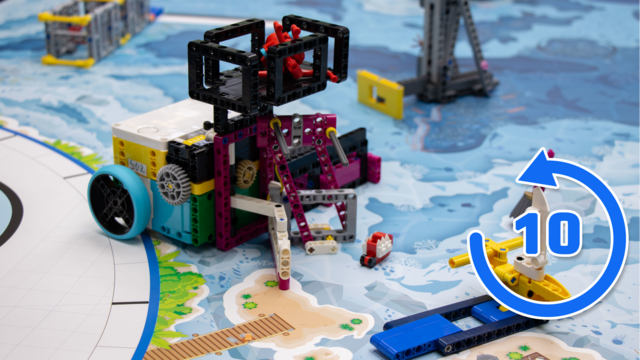
This is a recording of a completely perfect, 10 out of 10 accomplishment of a two-part mission - Train tracks, from the FIRST LEGO League 2021-2022 Cargo Connect competition. Due to the proper use of motion and color/light sensors, the robot is 100% consistent and reliable for a non-trivial mission. Even when the robot makes a mistake, it auto-corrects and compensates for this mistake.
In this video tutorial we accomplish the FIRST LEGO League 2022 missions called Wind Turbine, Television and Rechargeable Battery. We demonstrate how 3 missions could be accomplished in the single run and in the same time with a single attachment.
"Muni" is short for mountain unicycles - Munis.
This robot is designed to resemble a clown on a unicycle. It uses a large technic gear ring to move forward and backward. On top of the robot is a force sensor, disguised as a clown. You can program it so that when you touch its head, the robot starts!
A FIRST LEGO League 2023-2024 attachment for the MiniBox Robot.
This attachment is designed to detach, once it completes its purpose. Due to the way, the attachment is left on the mission model, it slides from, creating distance between itself and the mission model, therefore meeting the requirement that no attachment should be touching the mission model at the end of the competition. This is done, so that the team loses less time switching attachments in the base, lowering the chance of human error during the competition.
The robot is equipped with two motors, one on each side. As a result, whenever the robot turns, it always follows a curved path, also known as an arc. The size and radius of this arc depend on how the robot is programmed to turn.
We could calculate how long the motor should rotate at a certain speed in order to reach the required position, but in this case that is unnecessary. Instead, it is much easier to use the motor.run_for_degrees() command.