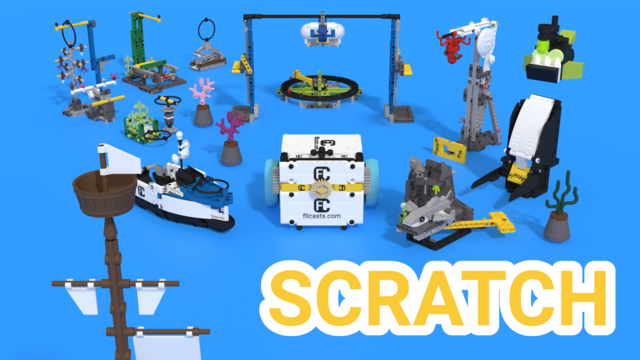
In this video tutorial, we are doing a 10 out of 10 for 2024-2025 SUBMERGED competition, where we collect the Krill, collect the samples, do a rotation work, lift an attachment, collect and deliver. We have to collect the loops, we have to push. We have to deliver the monster. A lot of missions. 10 out of 10. Let's see how it goes. This is a rather long recording. Ten minutes. So we'll try to discuss some of the things about this robot and see how consistent and reliable it is.
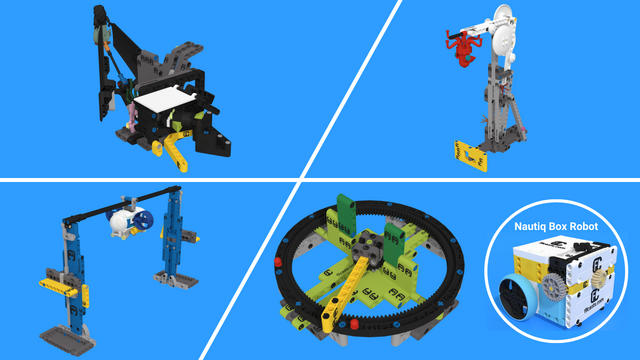
First thing to consider is that we move from one side of the field to the other side of the field. And while we are moving, we try to accomplish as many missions as possible. In a previous tutorial, what we did is we showed the other box robot that we are using for this competition, the Nautiq box robot. And what we saw there is that we accomplish, like, a few of the missions. Here we are trying to accomplish more.
What's the downside? The downside is that the previous run was taking 25 seconds. This run is taking, like, 35 seconds. So it's timing. Now, we can have the argument that we are doing two missions more. But because we are doing two missions more, sometimes they are probably not consistent and reliable as we would like them to be.
We move, we collect the Krill and the coral. We collect the samples - two things. We do the sonar - three things. We leave the attachment for the submarine - four things. Not the attachment, the mission model. We drop the monster - five. We take the seabed sample - six. The loop - seven. And we collect the two Krill, not Krill - there are, like, corals there. So it's eight things that we are doing with this robot. And it behaves in a rather consistent and reliable way. I think we did, like, nine out of ten here. This robot looks kind of like the previous one. It has a huge container at the front to keep all the parts in.
It has an attachment at the front and an attachment at the back.
As we move with the robot, we again, don't exactly follow lines and don't align to lines. We kind of align to the mission models here and there. Once we lift the submarine, we kind of align there, but that's it. The robot is consistent enough to move from one side of the field to the other without too much use of the light sensors. Now, it's difficult to achieve this, but it's possible. And there also aren't a lot of places here on this field to actually align if you are using the light sensors, of course. In previous competitions, where we had the field with only one base, it was kind of like mandatory to use the color sensors to align to different lines. Here, it's because the two bases, the one on the right and the one on the left, are closer to each other, we see that teams prefer to go along with a reduced use of the color sensors, which is fine. Like the whole competition kind of reduced the programming expectations and reduced the complexity of the programming. And we are left with the complexity of the mission models. Which, I guess, it's funnier this way because once the complexity of the program gets a little too difficult, too complex, it's really not possible to have a lot of fun because it's all programming. Now, the competition has never been in this way, but it's an interesting comparison. With the years, I see that programming is a little bit left to the side. While the competition focuses more on interesting attachments, interesting mission models that require two or three interactions for the mission model to be accomplished.
What else do we see here? Attachment at the front, attachment at the back, attachment that has an axle and it's an active attachment. And we use it to collect the loop. And we also use the same attachment to release the Monster. So it's 1, 2, 3, 4, 5 different things that these two attachments at the front and on the back are doing.
And this is powerful. This allows us to accomplish a lot of the missions.
I will leave you - just take a look and see how consistent and reliable the robot is until the end of the video. I hope this is helpful and I'll see you in the next tutorial.