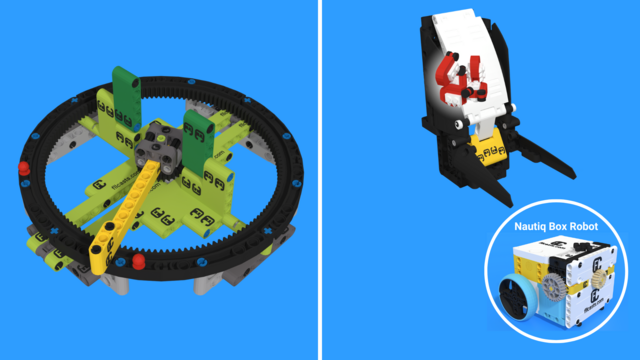
This is a 10 out of 10 tutorial on how we accomplish missions from FIRST LEGO League 2024. We use the Nautiq box robot with a rather big attachment. Our goal is to precisely deliver the Krill into the mouth of the whale. And to accomplish this rotation work mission, called the Sonar.
Two missions, 10 out of 10. Let's see how it goes. We start from base.
We approach the whale precisely drop the Krill, do the rotation work for the sonar, and we return back to base. What happens sometimes is that - you see it at the moment - we sometimes forget after a few runs, we forget that the end of this attachment might break. And when we do a recording again, and again, and it might break. So this time we forgot about it. The attachment was not properly attached. And this, this is why it failed the mission.
Always check, of course, it's common sense, but you sometimes miss it, and we miss it. Always check the attachments before the run.
Second try.
The Krill are delivered to the whale and the sonar is fully rotated. So, technically, on the sonar, we should reveal something that's on the mat below the mission model. But like, it's rotation work. It's a mission that we classify as an action called rotation work because the robot must do some rotation work.
What we try to do is to classify different types of missions so you can then search and figure out: "Okay, how am I going to accomplish this?" It's some kind of a rotation work. So let's go and let's see other missions that are in the same action that they are trying to accomplish. They do some rotation work. Third run or fourth.
A couple of other interesting things about this rather large attachment. You can see at the front of the attachment, there are these yellow angled beams.
These are angled beams that help us align to the mission model. We need to align to the mission model - the whale.
By aligning there, we know where exactly we are on the field, and we know exactly we're related to the mission model. And it's very easy for us to then precisely drop the Krill that are in the container. We just move. We align. With the alignment, we push and we open the mouth. And the mouth then opens the container. And the container, when it is open, it releases the Krill into the mouth.
Now, could we accomplish this mission earlier as a strategy? Technically, we could. But it was difficult. It was difficult. We had to collect all the Кrill, and some of the Кrill are on the other side of the field. So that's why we decided, okay, let's try to collect all the Krill and then return here and do this mission.
We again try to group the two missions in a single run. So, if possible, when the mission model is not directly next to base and these two mission models are on the other side of the field, try to group the missions in a single run.
The reason is that this will save us time. And you can always have an attachment at the front of the robot, and an attachment at the back of the robot. If you use the front and the back, and if we can accomplish one or two missions with the attachment at the front, one or two missions with the attachment at the back, then we can accomplish a few missions with a single run, which saves us time. A few more runs.
With this run, the robot is like 9 out of 10. There was a case where it missed the mouth of the whale. But it did the sonar and then returned back to base.
So, 9-10 out of 10, that's an okay result. Notice that we don't specifically use the line that we have in front of the whale - the white and black line, because we don't need to. Because we simply don't need one.
We go there and we try to align with the two yellow angled beams at the front of the attachment.
Sometimes it doesn't work. But notice that even if it doesn't work, we continue to the sonar and we accomplish the sonar. The container is not open and if we have enough time, we can decide, okay, would the Krill bring us more points than a different mission? And we can repeat the mission, which is nice. Even if the mission fails, we can repeat it . Like the way it fails at the moment.
What we were wondering here is why was the robot turning a little bit to the side? And we noticed that it was caused by the wheels. So, we had to clean the wheels. The way we clean the wheels is with a wet wipe. We clean the wheels. After a whole day of recording the wheels were kind of dirty.
This shows a different tool that you can use during the competition before every run, to have a consistent and reliable behavior. Try to clean the wheels with a wet wipe and then with a dry one. Just make sure that there is no liquid and then the robot will behave more consistently and reliably.
We try again. Move. 10 out of 10. A rather complex mission with a very interesting multi-purpose attachment. I hope this is helpful and I'll see you in the next tutorial.