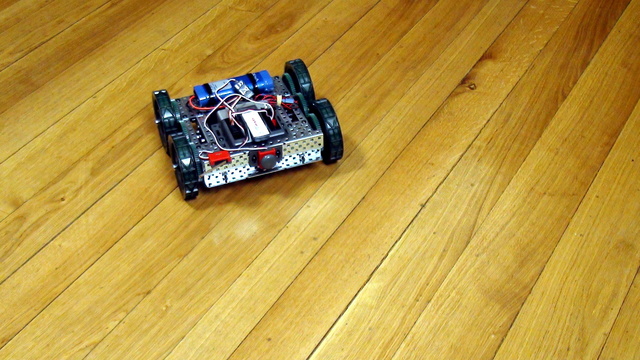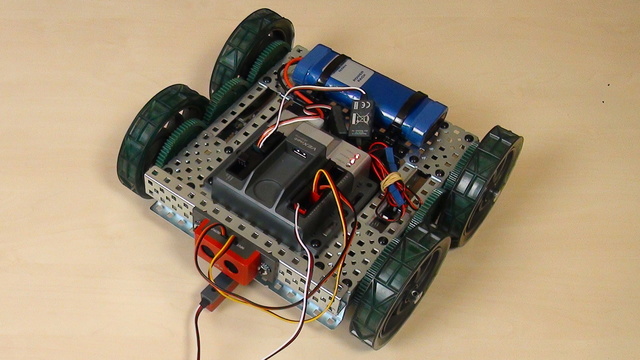
Description of the perfect STEM Course package and its contents.
In the course, we are going to use the following components and hardware elements. It is important to know their names and what are they used for.
- #674
- 01 Feb 2018
In the course, we are going to use the following components and hardware elements. It is important to know their names and what are they used for.
We are ready to build the first program for moving the robot forward and backward. We learn how to build simple programs for moving the program. But it is not that easy...downloading to the robot does not always result in the robot moving.
In this 10 out of 10 tutorials we do 10 runs that demonstrated how consistent and reliable it is to stop at the second intersection. This is useful as it is one of the main ways to figure out how to position yourself on the field.
In this video tutorial we follow a line 10 consecutive times. In this way we demonstrate whats the consistency that you could expect from the robot when following a line with a multi-states algorithm.
To control the VEX Cortex controller we must use a software. In this episode we would download the software from the VEX site. Strange thing is that you must select your region correctly even if you are not in this region
In this video tutorial, we demonstrate a reusable attachment. It is the same attachment we've previously used for two other missions. Sometimes we can build such attachments - one attachment that can complete several missions. Yes, the mission is similar - it is Load Cargo, but we are loading the cargo in different places on the field, and that's important.
Without the use of the sensors, make sure that you are at least using "set movement acceleration to slow". In this tutorial we will demonstrate why and how this helps us improve the accuracy and consistency of the robot.
We would start connecting a lot of things to the Raspberry Pi. It will be good if we could have some way of referring to the pins on the Raspberry Pi. For example like Pin 5 or Pin 26. Luckily there is such a way.
Why we change the robots all the time and what to observe in each new robot.
How to keep the discipline in the classroom and how to cheer up the students.
To prepare the robot to move in a square and to use a loop in the program we would first make this VEX EDR robot move forward and turn, using a program developed with RobotC.
Spinning with the VEX EDR robot involves the use of both motors. The left and the right. Every robot with wheels could spin and this makes not exceptions.
In this tutorial we demonstrate how accurate the robot is when we are moving it slow vs when moving it fast. The point of the tutorial is to show that moving slowly is generally much more accurate. It is not accurate enough for a FIRST LEGO League competition, but if you have to move without the use of the sensors you can at least move slow.
Where is the math while turning? Is there any math involved? Should there be?
The next important step when turning with a robot is to learn how to do an Arc turn.
This is an animation of a quick pinless attachment that is placed below the robot and is used to deliver parts, like the Container Mission model, to different parts of the field. In the live video in the lesson we explain more about the principles, while here in the animation you can get a quick overview of how it works and you can try to follow the same principles for an exercise.
This is a 10 out of 10 video tutorial demonstrating the consistency and reliability of a configurable attachment. The attachment is designed to accomplish the FIRST LEGO League 2021-2022 Cargo Connect mission model called Sorting Center. The mission model has 3 cargo objects that could be placed in a different way. The attachment is configurable and before the run we configure it for the specific way in which the mission model is set up before the start of the round.
In this video tutorial we accomplish a robotics competition mission model and we accomplish it 10 out of 10 times. The mission is Pull-up from the FIRST LEGO League 2020 RePLAY competition. The goal of the mission is to pull up the robot on the bar. The robot must not be touching the ground.
In this LEGO robotics video tutorial we will accomplish mission 8 from the FIRST LEGO League 2020 RePlay competition. The name of the mission is Boccia. What you will learn from the video is how to accomplish complex missions that require following a line, aligning to the line and accomplishing many mission models in a single run
We need to extend the cables to be able to connect them to our Raspberry PI. We must also add new connectors at the end of the cables.
How does this construction of VEX EDR turn? It has two motors. Let's start with turning right
In this video tutorial, we focus on M10 of the FIRST LEGO League 2023-2024 MASTERPIECE Challenge competition. We use the Chain Monster, a LEGO Education SPIKE Prime robot, equipped with a three-axle attachment. The mission's objective is to lift the sound mixer sliders and position them precisely to score the maximum points. While the mission may seem challenging at first, once you understand how the attachment works and how to properly connect it to the robot, it becomes a breeze. Let’s give it a try!
This video tutorial contains a details explanation on how we accomplish the FIRST LEGO League 2018-2019 Into Orbit mission called M06. SPACE STATION MODULES. This again is a very interesting mission from the competition from which we could learn a lot of basic principles in the field of robotics.
We challenge you before we give you the theory: browse in the software and try to achieve the behavior in the video below.
In this tutorial, we would build a simple program for controlling the Tetrix robot motors with the GamePads. We use the stick and when the stick is pushed forward the motors move forward. When it is pushed backwards the robot moves backwards.
In the current course we would use a number of languages. Generally we would program the robots in EV3-G, but we would also program them in JavaScript to make the parallel with the JavaScript. The programming would include arrays, switches and loops.
In this part 2 of the LEGO video tutorial we accomplish the pull part of the M03 Energy storage from FIRST LEGO League 2022-2023 SUPER POWERED. Part 1 was about precise dropping, part 2 is about pulling as the model requires it