

How to use the start sound block with SPIKE Prime Word Blocks software
The SPIKE Prime software allows us to play all kinds of sounds! Here's how to do it.
- #2028
- 01 Jul 2022
The SPIKE Prime software allows us to play all kinds of sounds! Here's how to do it.

This is how we can draw whatever we want on our robot's hub display!

Sometimes we want a part to move more, sometimes less. Here are the pins that can help with that!

Have you ever wanted your robot to move as fast as possible? Or slower? Here's how!

Have you ever needed to make an arc turn? Do you know what an arc turn is? Let's find out!

Here we will learn our first turn, namely a spin turn!

This lesson presents lighter and more engaging material for students, and, when combined with the fun blocks, they often become distracted. Here are some guidelines that may help you.

Sometimes, we make a mistake in starting the robot, and we should stop it before its program runs out. Here's how to do it with a SPIKE Prime controller.
Have you had a block you want to delete? Or one you want to restore after deletion? Now you will find out how!

Most programs we write require several commands for the robot to execute to complete its task. Here's how to do it with SPIKE Prime Word Blocks software!
In this tutorial you will learn how to use tasks where you have to write text.

By default, the motors of the LEGO SPIKE Prime controller connect to ports A and B. What if we want to connect them to other ports? Here's how to change ports in the software.

In this tutorial, we will learn what the start block does when starting the program and where to find it.
In this tutorial we will learn what the first purple movement block does.

In this tutorial we will do a deep dive on all the options of the first purple movement block.
What a teacher should know when giving tasks to students:
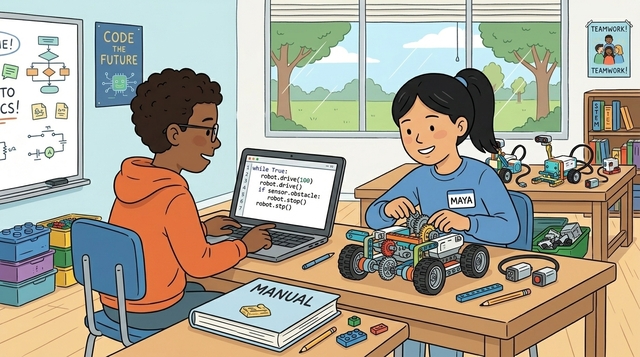
We will build a simple robot and learn how to follow building instructions step by step.
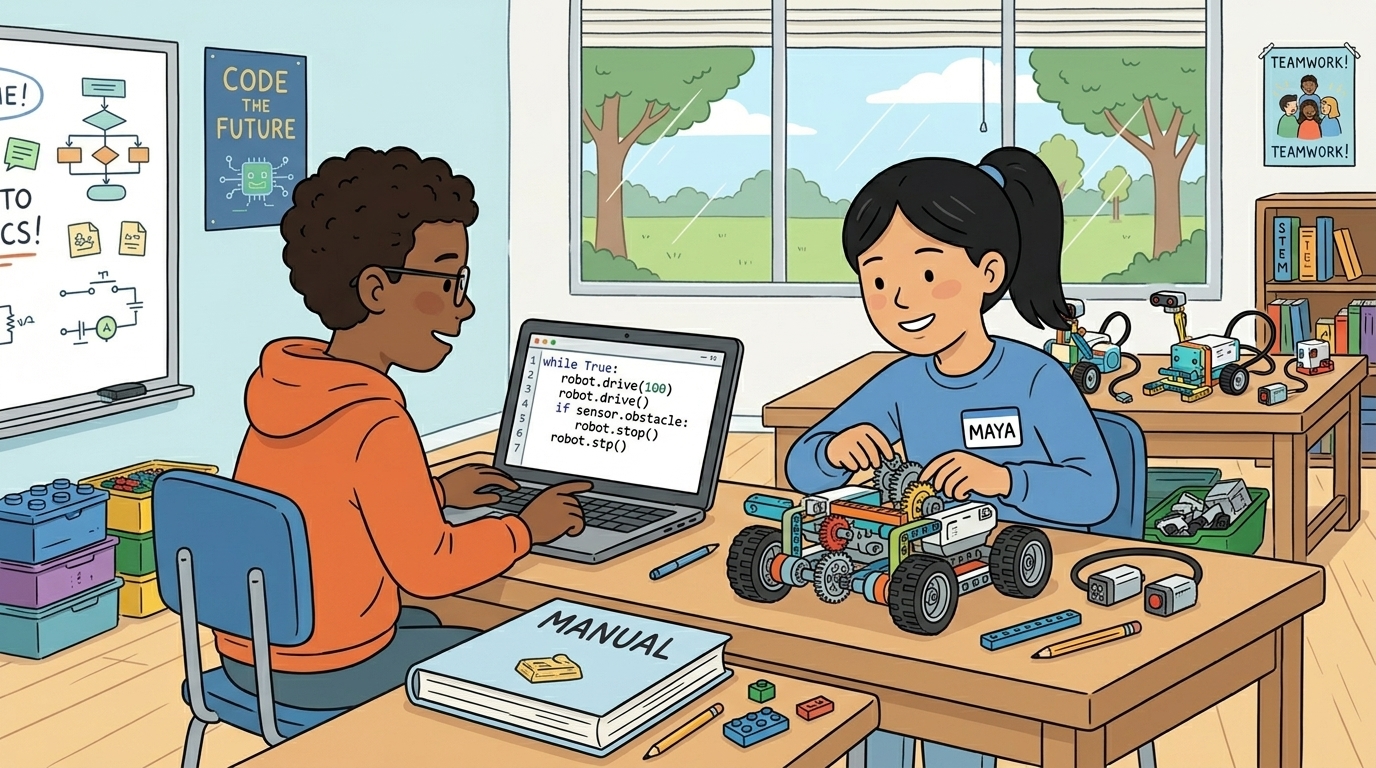
Children tend to imitate. The easiest way to do something is to first see how it’s done. So, sit down and show your students how to program.
We will cover the typical reasons why your robot is not moving at all.

This is what one of our simplest robots looks like:

EasyBot
Before we begin building, let’s take a look at some of the main parts of the robot.

Motors
Motors are like the "muscles" of the robot - they make it move.

LEGO SPIKE Brick
This part is called the "intelligent brick." You can think of it as the "brain" of the robot. It is a small computer where you upload your programs. It reads information from sensors and controls the motors based on your code.

Some of the main LEGO Technic parts in the LEGO SPIKE Prime set
There are many different parts in the image above. Can you match their names to the correct parts?
Tire
Rim
Double black pin
Long pin (triple)
Bush
Gear
Beam
Axle
Axle pin

In this video tutorial we follow a line 10 consecutive times. In this way we demonstrate whats the consistency that you could expect from the robot when following a line with a multi-states algorithm.

On the topic of following lines with a robot there is a way to make the robot follow the line a little more precisely. This method is called "Multi-states" program. Or at least we call it like this. In this tutorial you will see how we program 5 state for the robot line following program. This could be particularly important with FIRST LEGO League competitions where we must build consistent and reliable robots.

With this 10 runs we demonstrate the consistency and reliability that could be achieved with a LEGO Education SPIKE Prime robot and a 2-states simple line following algorithm. It is not bad. Still there are some things you should consider when using this program and one of the things is the use of the timers