Rubber bands - Solving the FIRST LEGO League World Class COMMUNITY TREE
Rubber bands can be quite powerful. Based on several requests from you we are starting a series on using the LEGO Rubber bands available in the Mindstorms set.
- #91
- 07 Jun 2015
Rubber bands can be quite powerful. Based on several requests from you we are starting a series on using the LEGO Rubber bands available in the Mindstorms set.
In this video tutorial we will show you three ways for making your robot stable on the field. We will present each one of them with their advantages and disadvantages - it's up to you to choose which one is the best for your case.
In this video we are solving one of the most important challenges on the FIRST LEGO League competition, i.e how to cover your Mindstorms NXT light sensors so that they are not affected by outer light sources at the day of the competition. Once again you would find 3 solutions and more will come in the next videos.
This one is very special- an attachment that could lock itself on purpose while working.
Cable management is very important on each competition. Cables could get in the way of attachments, levers, different wheels and so on. Brick accessibility is also very important. Do not forget that the brick should be charged from time to time and that you should also be able to access the buttons.
The way you move the robot is always imprecise. Don't TRY to fight with this. Programming motors for competitions like the FIRST LEGO League (FLL) or World Robotics Olympiad (WRO) is not very different from programming the motors in the STEM classes. But there are a few things you should have in mind.
Enchansing a previous attachment, but only this time we are solving the FIRST LEGO League 2012 Medicine mission. There is a lever and a rubber band. When the lever is released the rubber band activates the attachment.
Let's try to integrate more of the things we have learned into a single attachment. One that could accumulate energy, conserve it and use it at the appropriate time. All this because of a Rubber Band and a Flywheel - and if you don't know what a flywheel is you should definitely watch this videos
You need to pull. And also catch. You need a carabiner. We have done a number of videos on carabiners and this is one of the ideas for the FIRST LEGO League 2015 Trash Trek competition.
Here we continue examining FLL 2014 World Class missions. We show different ways, for putting the insert in place as well as taking the loop from the robotics arm. Some of them are quite specific, which reminds us, that you need to think out of the box, while solving the missions.
In this video tutorial we experiment with different ways of solving the sports mission for throwing the ball. We show seven different LEGO MIndstorms EV3 and NXT robot constructions and attachements. Most of the techniques could be applied for any mission involving throwing a ball or an object.
One of the very good things about box robots is that you could easily align with them both to the front, to the back or to the rear sides. This aligning is helpful for FIRST LEGO League, World Robotics Olympiad or other robotics competitions with LEGO Mindstorms EV3/NXT robots.
With the EV3 Mindstorms set you receive three motors. Two are large and one is medium. These three motors could be used in different configurations and in this video we show how to use the motors on the second box robot for competitions that we build.
We list the number of decisions that the robot is making while following the line. Then, we group them and decide on the number of sensors to be used.
In this Episode, we create the next attachment for the box robot two. It is again a pinless attachment, attached to the frame that transfers the motion to a vertical axle.
The first part of making the robot move straight is to keep it oriented straight. While it moves it could make an error and turn slightly to the right and then the program should turn in back to the left to make its orientation straight. In this video tutorial, we would discuss how to implement a program to keep the robot orientation straight even when we are pushing or pulling it to either side and in the same time it has different wheels.
In this video lesson I will show you how to follow a black line using just one sensor, but fast enough so that you could use it during any robotics competition without wasting any time.
Sometimes the way an axle is placed is just not suitable for a certain attachment and you should transfer the motion to another axle a few LEGO units above the current.
We follow a line. We start from the Smooth Proportional Line Following program and modify it a little for this program. We follow the line with the middle sensor attached on port 2.
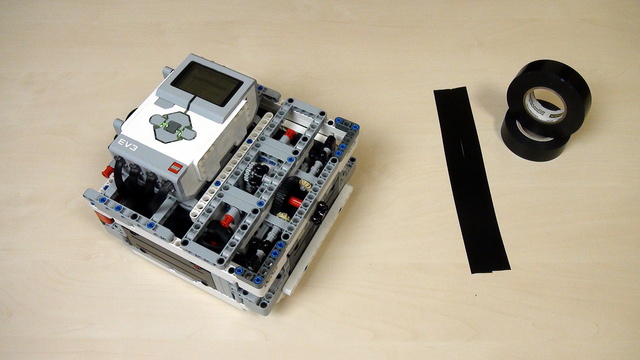
This robot has a color sensor and this sensor is used for following lines. Additional Mindstorms EV3 sensors could be place on the robot, like a Gyro sensor or a second Color sensor.
In part one we build an attachment that uses a rubber band to solve a competition challenge. The rubber band was released with the use of a motor. In this video we are removing the dependency on the motor and you could use the motor for other missions.
You are not using sensors?! You are positioning the mindstorms robot only by moving forward, backwards and rotating it. That`s one of the BIGGEST mistakes teams make on the FIRST LEGO League competitions. In this video we are showing a robot with chains and how imprecise are the results are when you are not using sensors.
Accomplishing many tasks with a single attachment for the FIRST LEGO League (FLL) 2013 competition. The attachments are using many rubber bands. What is interesting is that it collects/lift/triggers many things at the same time. This is how you could save time and parts during a competition.
How do you detect a cross-section and move from following the main line to following the crossing line. In this series of video tutorials we are starting with a very simple solution that could work in most of the cases. It is especially useful for the FIRST LEGO League Trash Trek competition where there is such a section.
Would you like to resolve all the problems with the light/color sensors that you have? And to make all of them work in a predictable, stable way even when using more than one MINDSTORMS colour sensors.
When using Color sensors it is important to calibrate them depending on the light conditions in your venue. In this way, the calibrated sensor will show values between 0 and 100 independent of the light conditions. But using the default EV3 colour calibration available in the colour sensor block could lead to unpredicted problems that are difficult to track and resolved especially when used with multiple Color sensors. So in this series of tutorial we implement the calibration ourselves discussing the principles of colour sensor calibration.
In this series we will do a short demonstration on the FIRST LEGO League Trash Trek 2015 solutions by one of the teams. These are example solutions with good tips and tricks along with some interesting strategies and videos directly from the team
This is the oldest and most classic problem in the field of robotics. Shaft in an opening. Basically robotics and in improvement of many of the actuators is about improving the solutions to such problems. Let's see how we ca do this using a mission model from the FIRST LEGO League (FLL) competition.