LEGO Education SPIKE Prime


Python program to accomplish FLL 2020 Robot Dance, with LEGO Education SPIKE Prime
This Python program is for controlling Gazon, LEGO Education SPIKE Prime competition robot to accomplish FIRST LEGO League (FLL) 2020 RePLAY Challenge mission 07 - Robot Dance.
- #i0chn6
- 18 Jul 2021


Common problems with motors not working
We will cover the typical reasons why your robot is not moving at all.
- #2003
- 01 Jul 2022


Mustak - LEGO SPIKE Prime simple distance sensor robot
In Arabic, "mustakshif" means "explorer."
This simple robot uses two wheels connected to medium motors for movement. It also has an ultrasonic sensor at its front.
- #1707
- 25 Jul 2024

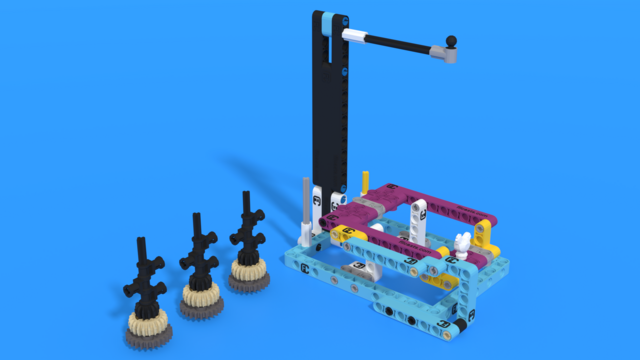
FLL 2024: Alternative model for M03 Coral Reef - Bags 3 and 4 - FIRST LEGO League 2024-2025 SUBMERGED
These are 3D Building Instructions for an Alternative M03 Coral Reef mission model for the FIRST LEGO League 2024-2025 SUBMERGED competition. For the original mission model, see M03 Coral Reef.
- #2957
- 06 Aug 2025
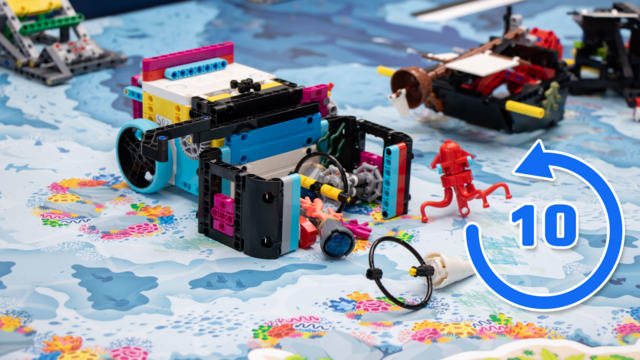
FLL 2024: 10 out of 10 on Collect, Deliver, Push - Nautiq accomplishing M05, M09, collect samples for M14, 3 Krill for M12 and Reef Segments for M03
This video tutorial focuses on accomplishing M05 Angler Fish, M09 Unexpected Encounter, collecting samples for M14 Sample Collection, 3 Krill for M12 Feed the Whale, and Reef Segments for M03 Coral Reef of the FIRST LEGO League 2024-2025 SUBMERGED Challenge using the Nautiq box robot (a LEGO Education SPIKE Prime robot). The run achieves a perfect 10 out of 10 score across these missions in one continuous sequence.
The robot collects and delivers samples, gathers krill and reef segments, pushes the Unknown Creature into the Cold Seep, and engages mission models with precision. The path is optimized for efficiency, combining multiple scoring actions with minimal wasted movement. You can watch the full explaining tutorial here.
- #2447
- 06 Aug 2025
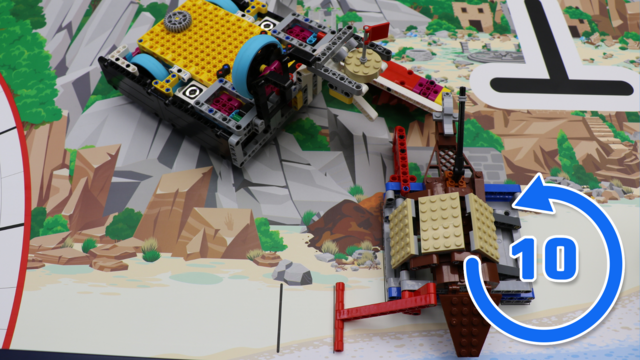
FLL 2025: 10 out of 10 on Push, Deliver, Grab - Smaller Pancake delivering a Flag for M15 Site Marking and accomplishing M12 Salvage Operation
Discover why this solution achieves a perfect 10 out of 10 successful runs in the FIRST LEGO League 2025-2026 UNEARTHED competition. Using the Smaller Pancake box robot together with this passive attachment, we analyze the design choices that make the completion of Mission 15: Site Marking and Mission 12: Salvage Operation remarkably consistent.
- #2650
- 05 Aug 2026