

EV3 Phi. Teacher's note about a cup of water on the robot
How to place the cup on the robot so that the challenge is challenging.
- #405
- 10 Apr 2017
How to place the cup on the robot so that the challenge is challenging.

Attach an axle to the front of the robot. Find a similar one, or modify the FTC Tetrix robot to accommodate the new axle.

The power in the car comes from the batteries. The batteries are in a batteries holder. About 5 of them. Two cables are connected to the batteries holder. It is very important to identify which of those cables is the plus and which is the minus.

Take the hacksaw, the drill and let's cut the pipe.

The robotics tutorial is about the shape of the pipe its advantages and disadvantages.

This is the task for you. We've shown you in the previous tutorials how to do it, how to use a drill and a hacksaw and a grinding stone to cut and shape a PVC pipe. Now it's your turn. Don't forget to show us pictures -> right here in the comments section

This robotics tutorial is about the different tools that you could use to collect the balls in a pipe on a FIRST Technical Challenge competition.
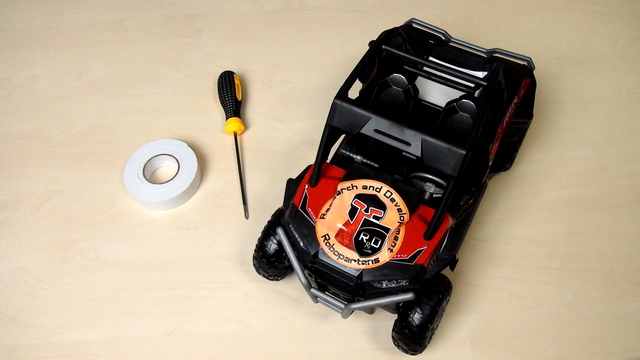
The course is designed to be used with almost every remote controlled car. The process of opening the car will be different for different cars but there are basic principles that you could follow.

The problem with the attention of students
We all know that it is very hard to control students’ attention even in an in-person classroom and it is even harder in a remote learning environment from home.
Now with remote learning, a teacher must be even more engaging, and the best teachers integrate more and more playful based learning so that students are interested and involved.
In this article, we will share how to achieve that, what are the best practices and benefits and how to convince your decision-makers to allow more play-based learning in your virtual and physical classrooms.

The goal of this lesson is for students to have fun with a new robot.
The goal of this lesson is to introduce students to the setting for measuring the reflected light of the color sensor and to recall how to follow a line.

Third wheel experiments, changes in the robot, students could choose the task all by themselves. Make sure you have a lot of fun and students complete their tasks. Here is what you should know when conducting this class.

There are two types of inertia to familiarize yourself with. One you know intuitively, while the other is more obscure. Both must be considered when building your own robots, especially in future competitions.

Your first task is coming up! Let’s see how tasks work and how to complete them.
In this course, you will work with videos and tasks.
Videos are marked with the  icon. They will show you how to use your robots and guide you step by step.
After every few videos, you will complete a task to practice what you have learned. The best way to learn is by building, testing, and trying your own ideas.
Tasks are marked with the labyrinth  icon and include clear steps to follow.
These steps break the problem into smaller parts that are easier to solve. Follow them carefully.
When you start a task in class, click the "Started" button below it.
When you finish all the steps, click the "Completed" button to mark the task as done.
If you have difficulty with any step, ask your teacher for help. You can also write your question in the comments section.
You can upload an image to show that you have completed a task. Some tasks require an image, while for others it is optional.


