

How to connect a Light Emitting Diode (LED) directly to Batteries
These are 3D building instructions on how to connect a diode directly to the batteries and turn it on.
- #443
- 17 Mar 2018
These are 3D building instructions on how to connect a diode directly to the batteries and turn it on.
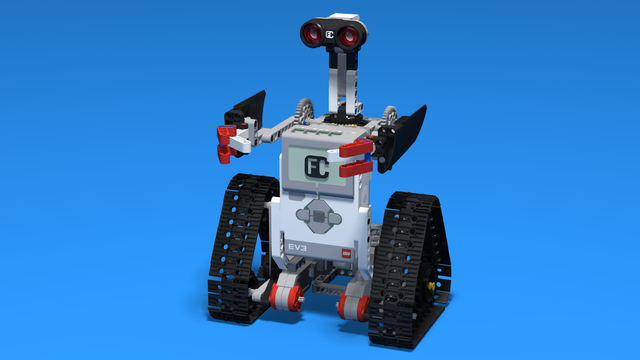
The new Spy is a robot with tank treads, which uses one medium motor to turn three things at once. That is achieved by a gear system. Simultaneously the robot turns its two hands up and down, but in opposite directions and its head - left and right.
The robot moves with the help of two tank treads, attached to two Large EV3 Motors.

Building instructions for LEGO EV3 catching robot. It uses a medium motor to drive system of gears, which is used for catching objects. It, also, has an ultrasonic and colour sensors for detecting the objects.

Instructions for building a LEGO truck. We use a medium motor for steering and a large motor for driving one of the rear wheels.

Building instructions for a LEGO EV3 Robo-tank. The construction is incredibly simple, with an upright Brick, which makes it perfectly suitable for lessons with students.

"You need to step on three points to be stable". This is something you could directly see after building this marvellous, 270+ steps, extremely interesting Motorcycle with a side cart. Yes, we are proud of it. The robot is suitable for using it at home. The instructions for building it contain more than 270+ steps so it is a test for endurance, concentration, passion. The same way driving a motorcycle is.
Or you could just step into the cart, drive along and enjoy the view while someone else is building the robot. Like a sibling or a parent.
Join the course A robot a "day" keeps the questions awake where we will further discuss the motorcycles, how to build them and what tasks to accomplish with them.

This robot is for learning at home when you have time and energy. It is like having a motorcycle on your own - you spend a lot of time working on your motorcycle, you love it, it takes care, it takes patience. This robot has 300 steps in the building instructions. We've heard a lot of parents with students telling stories how their student could build anything from LEGO on their own. This motorcycle with a cart surely would be a challenge for them. Send us pictures when they are done.
Join the course A robot a "day" keeps the questions awake where we will further discuss the motorcycles, how to build them and what tasks to accomplish with them.

Building instructions for probably the simplest LEGO Mindstorms EV3 Motorcycle that you could think of. Can you think of a simpler? Build it and send it to us.
The motorcycle has one large and one medium motor. Turns are hard, but we will think of solutions for turns. There are also other motorcycles, more complex ones that you could build
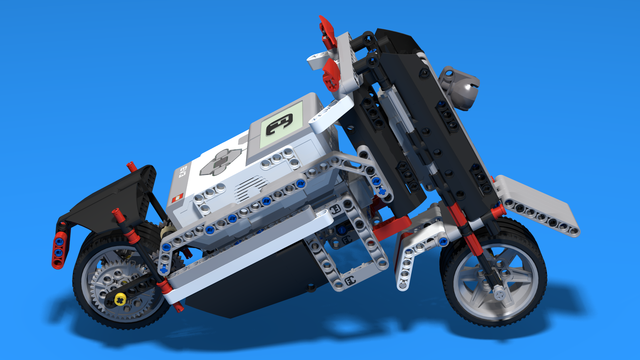
It's fast. It's on two wheels. It's a motorcycle. And this one is built from LEGO Mindstorms EV3 sets with the use of one additional Medium Motor. If you have two medium motors, great. If you don't have you can build the Handlebar - Chopper Motorcycle built with LEGO Mindstorms EV3, because it uses one large and one medium motor that are available in any EV3 set.
Currently, the motorcycle has no sensors. It's more of an exercise in construction, but if you attach sensors and think of a way to attach them send us a picture.
Join the course A robot a "day" keeps the questions awake where we will further discuss the motors, how to build them and what tasks to accomplish with them.
You can also download the program from here.
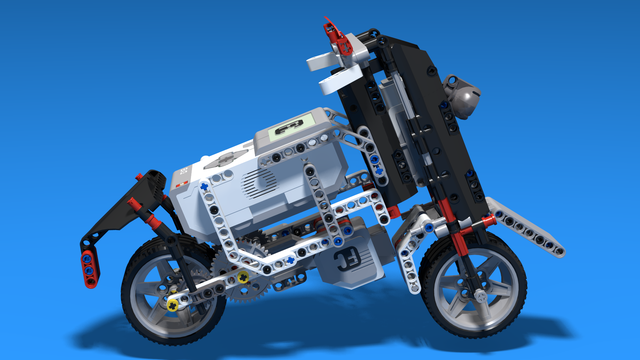
Take a motorcycle and start removing parts. You get a chopper. Like this one. It is built with LEGO Mindstorms EV3. It has one large and one medium motor. It could kind of turn, but moving forward with it is very funny. There is a "more sports like version" available at Ninja - Sports Motorcycle built with LEGO Mindstorms EV3
Currently, the motorcycle has no sensors. It's more of an exercise in construction, but if you attach sensors and think of a way to attach them send us a picture.
Join the course A robot a "day" keeps the questions awake where we will further discuss the motorcycles, how to build them and what tasks to accomplish with them.


These are instructions prepared by LEGO.

This robot is part of the category of robots called animals. After following the building instructions you would have a frog that could jump. Of course, the jump depends on the surface and the friction between the robot and the ground... quite complex physics involved. But if you program it to move forward it will try to jump and it is your job to try to make it jump higher.
You could try to extend some of the legs, for example.

Building instructions for a LEGO Mindstorms animal that looks like a Penguin, and walks like a penguin and if you program it, it will even talk like a penguin. Can you program it to talk like a penguin?

We had a couple of minutes before starting another robot and we just came up with this robot. If you would like to build a Box Robot, but don't have enough parts this is a good construction that you could learn from. It has a frame. It has three motors. You can add attachments at the top.

Maze Runners are one of the very popular robotics competitions. But there are a lot of limits that the robots must comply with. Like the size of the robot.
This here are building instructions for a very small maze runner robot, build with LEGO Mindstorms EV3. It uses two tires that are technic and not Mindstorms simply because none of the Mindstorms tires fit the size limit.
The robot has an Ultrasonic sensor and a Gyro sensor at the top.

The building instructions are for a robot that kind of looks like the Spy Bot but it has treads instead of wheels. Like a Tank. Tank Spy Bot. Treads are always funny and you could use the robot chassis base to extend with additional attachments and tools.
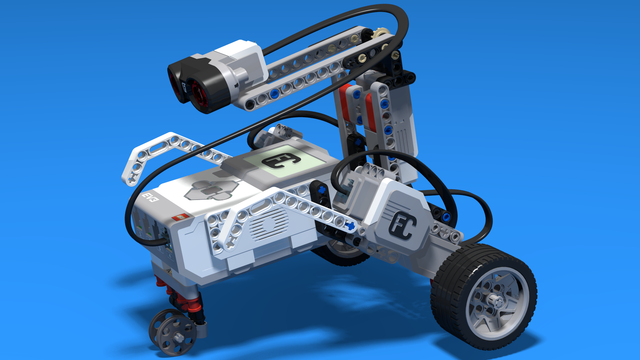
Following the Spy Bot, we have this new Spy Vehicle. Yes, yes it is using an ultrasonic sensor.
The building instructions are for a robot base that looks like a car but is not exactly a car and has a strange shape. Just like spy vehicles - a car, but not only a car and not just a car.

"How do you build a forklift using only gear wheels and levers without a rake"... Ok, we would admit that is a difficult question. It even sounds difficult. So let's start with something easy. A LEGO Mindstorms EV3 robot. It lifts objects in the air. It uses two gear wheels that work together and then move in different directions and are placed perpendicular to each other... This sentence kind of got difficult again... Let me try again.
Follow the building instructions with these 70+ steps and you will have a very nice robot and you will learn a simple trick of how to use gears and change the directions in which they rotate.
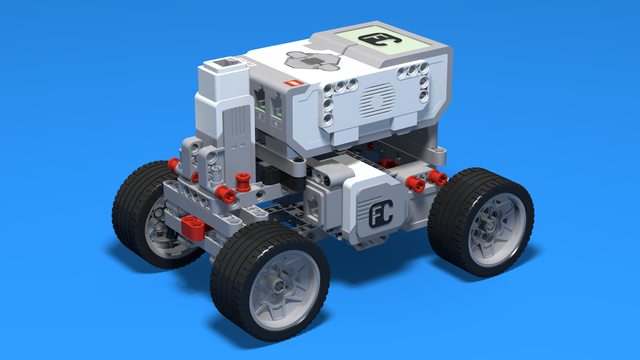
Building instructions for a LEGO EV3 steering car. We use two large motors, so that the rear wheels will be driven independently by a separate motor. For your convinience, you can use the EV3-G MyBlock for moving the Boomer.

Building instructions for a simple car using an EV3 Large motor for turning the front wheels and EV3 medium motor with differential for driving the rear wheels.