

Catapult Full - Full catapult from LEGO Mindstorms with a Motor and a Touch Sensor
These are building instruction for a working automatic catapult with a motor and a touch sensor.
- #205
- 01 Feb 2015
- 1
These are building instruction for a working automatic catapult with a motor and a touch sensor.

This attachment is meant to be built on the robot Francesco 2. When the red connector for the transmission connects the two axles for the rear gear wheels, the differential locks and the motor starts evenly transferring its power to both wheels.
When the red connector for the transmission is pushed to the side, the differential unlocks and once again transfers its power to the wheel with least resistance.
You can see empty beams hovering over this attachment. They are there so you can attach a lever construction over it, to help with the locking and unlocking of the differential. Similar leaver can be seen in the robot Catapult.

Building instructions for a safe mechanism. The medium motor can be used for dialing in the key lock. The brick buttons can also be used for a pin code input.
One of the large motors unlocks the latch, the other one opens up the lid of the safe.

LEGO Mindstorms EV3 Robot designed for a Folk Race competition. This robot has three Ultrasonic Sensors. Follow the building instructions and at the end, you would have a very basic robot with tank treads that you could directly use.

Hrutur, from Icelandic, means Ram.
The robot is made to resemble a Ram. Its main focus are the gears, which make it go faster so that it can ram harder. It uses two Large EV3 motors to power the gear systems. At the front it has an Ultrasonic sensor for aesthetic purposes, which you can use however you like.

Lintu means bird in finnish.
The robot is made to resemble a Kiwi bird, an endangered species of flightless birds, found only in New Zealand.
Lintu uses two large motors as legs. They are placed at an angle so that they resemble the strange posture of the kiwi bird.
The beak of the robot uses an interesting mechanism to open and close utilizing two technic steering links and a medium motor. For eyes, the robot uses an Ultrasonic sensor.

Accomplish three FIRST LEGO League missions at once. This is an interesting Large multi-purpose FLL attachment for a box robot that could be used to accomplish a number of missions with a single exit of the field base.

Building instructions for constructing a simple LEGO Model that has red, green, blue and yellow beams. This makes it perfect for operating robots through color code.

This is a LEGO Mindstorms Boxing robot. The inspiration story goes like this "One day we though - Let's play SUMO at this robotics demonstration, but let's make it more interesting. Let's play sumo with Humanoid Robots". We decided to build a boxing robot. The goal of the robot is to press the touch sensor on the other robot and it could be very fun. Perfect robot for demonstration. It is controlled by a joystick using the Bluetooth connection.
Here are the joystick and the programs for the joystick and the robots.

This is Cooley, and, it, is, coooooool. It got all the stuff the cool kids have - two motors at the top, two at the bottom, two wheels on the side and it is slim. Build a few attachments for it and take it on a ride during FIRST LEGO League competition

"You need to step on three points to be stable". This is something you could directly see after building this marvellous, 270+ steps, extremely interesting Motorcycle with a side cart. Yes, we are proud of it. The robot is suitable for using it at home. The instructions for building it contain more than 270+ steps so it is a test for endurance, concentration, passion. The same way driving a motorcycle is.
Or you could just step into the cart, drive along and enjoy the view while someone else is building the robot. Like a sibling or a parent.
Join the course A robot a "day" keeps the questions awake where we will further discuss the motorcycles, how to build them and what tasks to accomplish with them.

Building instructions for a LEGO Mindstorms EV3 Active attachment for changing gear orientations

The GorillaBot walks on its two arms, using two large motors as forearms. It also has this awesome head, which actually is pretty useless as an ultrasonic sensor, unless you lift its eyebrows.

Space stations allow us to learn about and even practice living in space, but improved technology and new international partners require modules to be easily interchangeable.
The robot needs to remove and insert modules among the habitation hub’s portholes.
(mission descriptions source https://www.first-lego-league.org/)
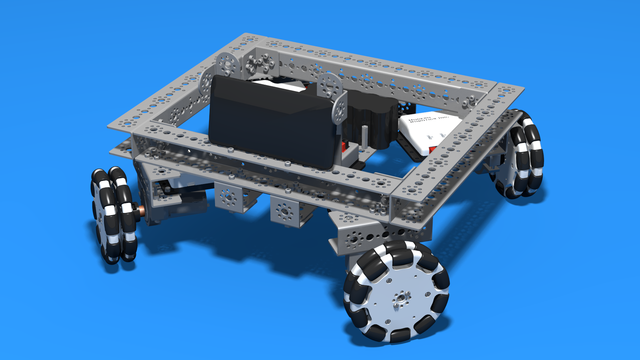
We've built a box robot chassis that could easily be extended with attachments for FIRST Technical Challenge competition.
If you ever felt that FIRST Technical Challenge is difficult and you don't know where to start from, building this Tetrix robot is the first thing that you could do. You would have 4 motors, plenty of space for attachments and good access to the phone.
The robot is built from a Tetrix Set without additional parts. It's a winning robot in just 109 steps

This is an attachment that could be easily detached. It's built with LEGO Education SPIKE Prime parts and it demonstrates how to build an attachment that could be easily detached. In competitions you need this easy detachment as on FIRST LEGO League/World Robotics Olympiad and other robotics competition you need to save time. The principle is the same. The attachment is designed for Luly, small LEGO Education SPIKE Prime competition robot with 3D building instructions. Check the course in which this attachment is used for more information and tutorials on how to use it.

A turtle robot with 2 sensors- ultrasonic and gyro, capable of following her course and navigating through anything. Just don't annoy it, or it will hide in its shell or even come and bite you.

Maze Runners are one of the very popular robotics competitions. But there are a lot of limits that the robots must comply with. Like the size of the robot.
This here are building instructions for a very small maze runner robot, build with LEGO Mindstorms EV3. It uses two tires that are technic and not Mindstorms simply because none of the Mindstorms tires fit the size limit.
The robot has an Ultrasonic sensor and a Gyro sensor at the top.

This module is meant to be used in EV3 Kinesthetic and Memory Game and is attached to the base of the robot. This module uses the gyro sensor to detect when it is hit, by observing the angular rate.

These are building instructions for a LEGO WeDo 2.0 Small Creatuer