

Bag 4 - Step Counter - FIRST LEGO League 2020-2021 RePLAY
These are instructions on how to build the:
- Step Counter
You can find more building instructions and tips and tricks about the competition on this page.
- #1085
- 31 Aug 2020
These are instructions on how to build the:
You can find more building instructions and tips and tricks about the competition on this page.

Roberto is one handed robot with four bars mehanizm. He is more durable then Pesho.
This robot is based on Roberto Chassis.
Program for this robot available here.

Инструкции за робот, построен от ЛЕГО Mindstorms EV3. Казва се Франкенщайн, тъй като двата мотора са противоположни.

If you take a look at the videos for this attachment you will see a nice idea on taking the track and the ambulance. These two vehicles from the FIRST LEGO League 2013 competition had to be collected and returned back to base.
Built from LEGO Mindstorms EV3 parts.

Building instructions for a LEGO Mindstorms Catapult Motor and Touch Sensor that are used for triggers for firing objects
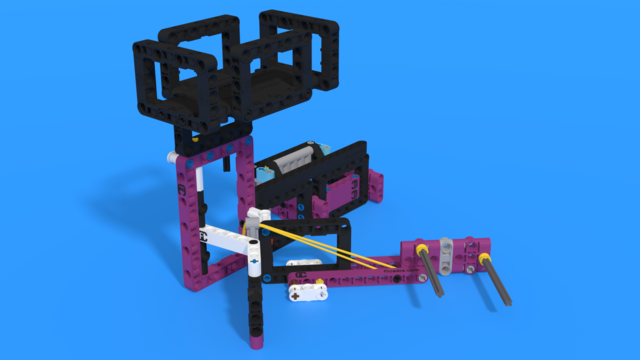
This attachment for the Nautiq robot is designed for missions M13 Coral Reef, M12 Raise the Coral, and M09 Release the Shark from the FIRST LEGO League 2024-2025 SUBMERGED competition. It features a passive mechanical trigger that releases a lever powered by a rubber band. A passive curtain mechanism is included for collecting parts from the field. The attachment is optimized for quick and reliable mission execution without additional motors.

Този робот се движи точно като виенско колело. Един мотор в основата му върти цялото колело. Седалките се държат изправени от гравитацията и можете да добавите малки ЛЕГО пътници на тях! Сензор за сила може да се използва за да се пуска и спира колелото.

These are 3D Building Instructions for the Expert Delivery mission model for the FIRST LEGO League 2023-2024 MASTERPIECE competition.

These are 3D Building Instructions for the Rolling Camera mission model for the FIRST LEGO League 2023-2024 MASTERPIECE competition.

This is the robot that we use to demonstrate a solution for the World Robot Olympiad 2021 Junior competition. This is a Post season solution. We never release any solutions during the season as this will have a negative impact on the competition.
We started with this robot and it has a few good ideas. It can collect two cars at the same time. We later decided to go for a more powerful robot. Check out WRO 2021 Junior: Slaimi - a post season WRO competition solution robot

This attachment was intended for and tested on the Gazon, LEGO Education SPIKE Prime competition robot. It is meant to help the robot complete the 3rd mission of the FLL Cargo Connect competition.

This is the attachment to accomplish Fll 2019 M06 mission with the Whakatae. You can see how to attach the attachment to the robot in this tutorial to do.
It also accomplish Fll 2019 M06 mission.

This is the attachment to accomplish Fll 2019 M01 mission with the Whakatae. You can see how to attach the attachment to the robot in this tutorial.

Луна 3 идва от съветският космически кораб със същото име, който е направил първата снимка на тъмната страна на Луната.
Този робот е направен да държи телефон, който може да се използва като камера за да направи снимка на тъмната страна на Луната. Роботът е сравнително прост, използва два големи EV3 мотора за да се задвижва и също има поставка за теефон. Тя е направена да работи с повечето телефони, но лесно може да я промените за да работи с всяка камера.

This is the attachment of Team "Nightbeast", with which they do:
M11–Escape Velocity and M13–Observatory
The Observatory result depends on the model. Sometimes the pointer is in the orange area otherwise in the white area.

This is a simple chassis that uses two motors to control the robot and two omni wheels at the back for greater maneuverability.
The program for this chassis is at programs/c0oq4l-pesho-bot-chassis-controls-with-modkit

This is the chassis for the popular FTC Push Bot. The robot is built with the Tetrix set and uses two motors. When preparing for a FIRST Technical Challenge competition (FTC) it is very useful to have a chassis from which you could start working. It might not, and will surely not be the final robot, but a good base is always useful.
With this chassis, we've also made a short course of how to control it. Take a look at FIRST Technical Challenge. Basic GamePads, control and attachments for the Tetrix set.

Simple VEX IQ competition base with a lot of space for attachments and gravity center in the backside of the robot.

A very simple base of the robot that could be used for adding attachments.
